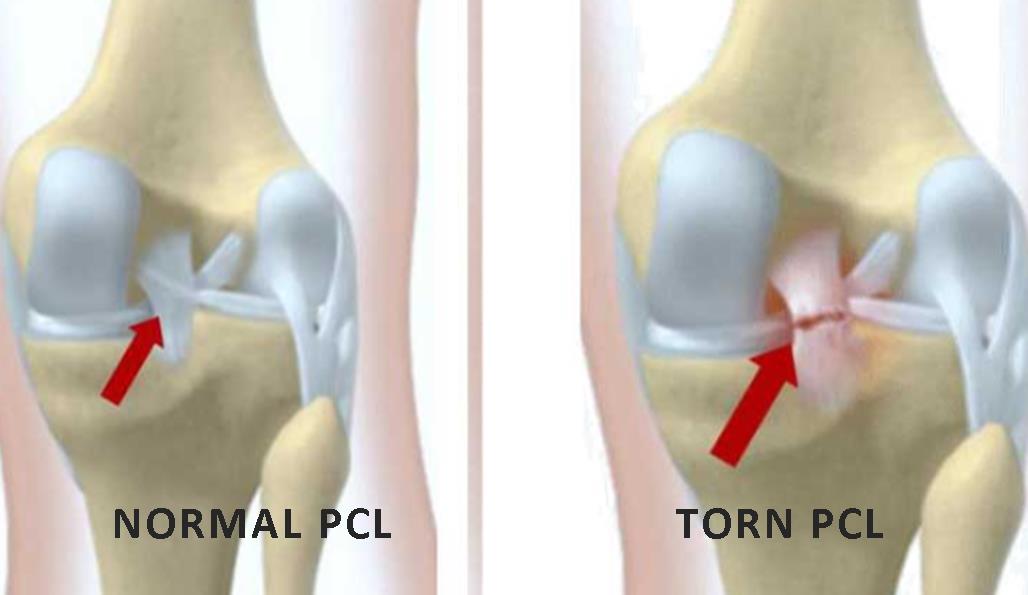
The posterior cruciate ligament (PCL) is the strongest ligament in the knee — yet it is frequently torn in road traffic accidents, contact sports and high-impact falls. Unlike ACL tears, PCL injuries are often initially under-diagnosed, allowing progressive posterior instability to damage the knee joint over time.
Dr. Harish Talreja is an experienced orthopaedic specialist in Jaipur performing arthroscopic PCL reconstruction — using both single bundle and double bundle techniques — at Manipal Hospital Jaipur. Early accurate diagnosis and appropriate treatment decision (conservative vs surgical) is central to his approach.
The posterior cruciate ligament (PCL) is the larger and stronger of the two cruciate ligaments in the knee. It runs from the posterior tibia (back of the shin bone) to the anterior medial femoral condyle (inner front of the thigh bone), crossing the ACL inside the knee.
The PCL's primary role is to prevent the tibia from moving backwards on the femur (posterior tibial translation), and to contribute to rotational and varus/valgus stability of the knee.
PCL tears are significantly less common than ACL tears, accounting for approximately 3–20% of all knee ligament injuries. They are most common in road traffic accidents (dashboard injury) and high-contact sports. Unlike ACL tears, many PCL injuries — particularly Grade 1 and 2 — can heal with conservative treatment, making accurate grading essential.
PCL: Prevents tibia going backwards. ACL: Prevents tibia going forwards and rotating
PCL: Dashboard impact, fall on bent knee. ACL: Pivoting, jumping, sudden direction change
PCL Grade 1–2 often heals conservatively. ACL Grade 3 almost always needs reconstruction in active patients
PCL: 9–12 months to sport. ACL: 6–9 months to sport. PCL reconstruction is technically more complex
PCL tears are often initially less dramatic than ACL tears — the absence of a loud "pop" and relatively modest swelling can lead to underdiagnosis. However, untreated PCL injuries cause progressive posterior instability and long-term articular cartilage damage.
Pain at the back of the knee — rather than the front or inside — is characteristic of PCL injury. Particularly tender at the posterior joint line and proximal tibia.
A sense that the knee "shifts backwards" or is unreliable on uneven ground, descending stairs, or during sport — the defining functional symptom of PCL deficiency.
Moderate swelling develops after PCL injury — typically less rapid and severe than the haemarthrosis of an ACL tear. Swelling is often most prominent posteriorly and in the popliteal fossa.
The knee feels unreliable going downstairs, downhill or on uneven surfaces — activities that place the posterior capsule under load when the PCL is absent.
Chronic PCL deficiency often presents as persistent aching during running, twisting and sporting activity — rather than dramatic giving way, which is more typical of ACL tears.
PCL diagnosis requires specific clinical tests, MRI confirmation, and stress radiographs to quantify the degree of posterior laxity. Accurate grading determines whether conservative or surgical treatment is appropriate.
With knee at 90° flexion, the tibia is pushed backwards. Posterior translation greater than 5 mm with a soft end feel is positive. Graded 1+ (0–5 mm), 2+ (5–10 mm), 3+ (>10 mm) corresponding to tear grade.
With the knee and hip at 90°, the tibial tuberosity visibly drops ("sags") posteriorly compared to the unaffected side. A positive posterior sag sign is virtually diagnostic of a complete PCL tear.
With knee at 90°, the patient actively contracts the quadriceps. In PCL deficiency, the posteriorly subluxed tibia actively reduces (moves forward) as the quadriceps pull on the tibial tubercle — a unique sign of PCL laxity.
MRI confirms the PCL tear, grades severity, identifies the tear location (femoral/midsubstance/tibial), and assesses for associated injuries — posterolateral corner, ACL, meniscus and cartilage damage.
Posterior stress X-rays with the knee at 90° allow objective measurement of posterior tibial translation compared to the uninjured side. A difference >10 mm indicates Grade 3 PCL injury requiring surgical consideration.
A tibial clunk during knee flexion-extension with external rotation indicates posterolateral corner (PLC) injury — which commonly accompanies Grade 3 PCL tears and requires simultaneous surgical reconstruction.
PCL tears are classified into three grades based on the degree of posterior tibial translation compared to the uninjured knee. The grade directly determines whether conservative or surgical treatment is recommended.
Partial PCL tear with minimal laxity. Posterior Drawer 1+. The tibial step-off (normal 1 cm anterior to medial femoral condyle) is maintained or only slightly reduced.
Partial to complete PCL tear. Posterior Drawer 2+. The tibial step-off is reduced (tibia at same level or just posterior to medial femoral condyle). No end feel on posterior drawer.
Complete PCL rupture. Posterior Drawer 3+. Tibia displaced posterior to medial femoral condyle. Associated PLC or ACL injury must be excluded. Stress X-ray confirms >10 mm side-to-side difference.
Unlike ACL tears, many PCL injuries can be successfully managed without surgery. The decision is based on grade, stability, associated injuries, and activity level.
Grade 1 and Grade 2 isolated PCL tears — these often heal with physiotherapy and PCL bracing
Sedentary or low-demand patients who can adapt activities to avoid posterior instability
Acute Grade 3 injuries — initial conservative management while assessing for associated injuries
Patients with medical comorbidities making anaesthetic or surgical risk unacceptably high
PCL bracing in extension, quadriceps strengthening, protected weight bearing for 4–6 weeks
Grade 3 complete PCL tear with >10 mm posterior translation causing functional instability
Combined PCL + PLC (posterolateral corner) injury — requires simultaneous reconstruction
Combined PCL + ACL injury — multi-ligament reconstruction required
Active athletes with Grade 2–3 injuries who want to return to pivoting or contact sport
Persistent symptomatic instability after a minimum 3 months of dedicated conservative rehabilitation
The PCL has two functional bundles — the anterolateral (AL) and posteromedial (PM) bundles. Dr. Talreja selects the optimal technique based on tear grade, residual laxity and individual patient requirements.
The larger and functionally dominant anterolateral (AL) bundle is reconstructed with a single graft — most commonly a hamstring tendon or allograft. This is the standard and most commonly performed PCL reconstruction technique, suitable for most Grade 3 PCL injuries without residual rotational instability.
Both the anterolateral (AL) and posteromedial (PM) bundles are reconstructed using two separate grafts — more closely replicating the native PCL anatomy and biomechanics. Provides enhanced posterior and rotational stability compared to single bundle, particularly in higher-demand athletes.
PCL reconstruction has a longer recovery than ACL reconstruction — the tibial tunnel healing (the "killer turn" effect) requires careful protection and a more cautious rehabilitation approach. Patience is rewarded with excellent long-term stability.
The AI overview cited ₹90,000 to ₹3,00,000 for PCL surgery in India. Here is a more specific breakdown for Manipal Hospital Jaipur patients.
Costs include surgery, graft, implant fixation hardware, arthroscope use and hospital stay. Associated procedures increase cost.
Dr. Harish Talreja offers accurate PCL diagnosis, appropriate treatment selection (conservative vs surgical), and technically precise arthroscopic reconstruction — using both single and double bundle techniques at Manipal Hospital Jaipur.
Arthroscopic Procedures
PCL Surgery Success Rate
Months Return to Sport
PCL injuries are often under-diagnosed. Book a consultation with Dr. Harish Talreja at Manipal Hospital Jaipur for accurate diagnosis, appropriate grading, and the right treatment plan for your PCL injury.
Shop No. 2/34, A Block
Vaishali Estate Township, Gandhi Path West
Jaipur – 302021
Book Appointment ›I had a good experience consulting with the doctor and he's really well mannered.
Feel free to pay us a visit. You won’t regret it for sure.