Meniscus Tear Treatment Jaipur — Knee Cartilage Injury Repair Meniscectomy | Dr. Harish Talreja

Meniscus Tear Treatment in Jaipur

  1. Home
  2. Services
  3. Sports Injuries
  4. Meniscus Tears
Decorative page header shape
Meniscus tear treatment Jaipur — arthroscopic meniscus repair and partial meniscectomy by Dr Harish Talreja
Knee Cartilage · Meniscus Repair · Jaipur

Meniscus Tear Treatment in Jaipur

A torn meniscus is one of the most common knee injuries — causing pain, swelling, stiffness, and in some cases a locking sensation that prevents you from straightening your knee. Not all meniscus tears need surgery, and not all tears that need surgery need the same procedure.

Dr. Harish Talreja is an experienced orthopaedic specialist in Jaipur with a repair-first philosophy — preserving as much meniscal tissue as possible at Manipal Hospital Jaipur, using arthroscopic meniscus repair where the tear location and pattern allows, and partial meniscectomy when repair is not viable.

5,000+Arthroscopic Procedures
Day 1Walk After Meniscectomy
4–6 WksReturn to Sport (Meniscectomy)
Repair FirstCartilage-Preserving Approach
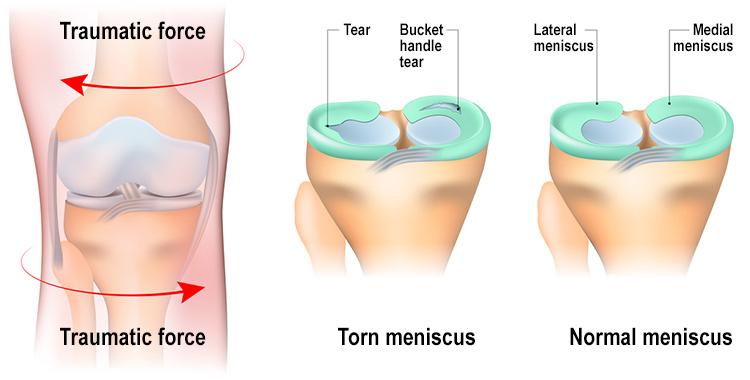
Meniscus anatomy — medial and lateral C-shaped cartilage in the knee joint cushioning and stabilising
Understanding the Meniscus

What is the Meniscus?

Each knee has two C-shaped fibrocartilage structures called menisci — the medial (inner) meniscus and the lateral (outer) meniscus. They sit between the femur (thigh bone) and tibia (shin bone), acting as shock absorbers, stabilisers and joint lubricators.

The menisci are critically important for knee health. They distribute load across the joint, protect articular cartilage, and contribute to rotational stability. Removing meniscal tissue permanently reduces this protection — which is why preserving the meniscus through repair is always preferable to removal when the tear location allows.

The medial meniscus is torn more commonly than the lateral — particularly in ACL injuries, where medial meniscus tears occur in 40 to 60% of cases. Lateral meniscus tears are more common in chronic ACL deficiency.

Conditions Treated

Meniscus Conditions Treated in Jaipur

Dr. Talreja treats the full range of meniscal pathology — from acute sports tears to degenerative age-related tears — with the appropriate conservative or surgical approach at Manipal Hospital Jaipur.

01

Acute Sports Meniscus Tear

Sudden twisting or pivoting during sport — football, cricket fielding, kabaddi, basketball. Often associated with ACL tear. Vertical longitudinal tears in the red-red zone may be repairable.

02

Bucket Handle Meniscus Tear

A large displaced longitudinal tear where a flap of meniscus folds into the joint — causing severe locking that prevents full knee extension. Requires urgent arthroscopic treatment (repair or meniscectomy).

03

Degenerative Meniscus Tear

Age-related horizontal or complex tears in patients over 40 — often with associated osteoarthritis. Conservative treatment is the first-line approach; surgery is considered only for mechanical symptoms unresponsive to 3 months of physiotherapy.

04

Radial Meniscus Tear

A tear that cuts across the meniscal fibres, disrupting the hoop stress mechanism that distributes load. These tears reduce meniscal function significantly and may be repairable if in the vascular zone.

05

Combined ACL + Meniscus Tear

Meniscus tears accompany 40 to 60% of ACL injuries. Both are addressed simultaneously during ACL reconstruction — the meniscus is repaired or trimmed arthroscopically at the same surgical session. See ACL Reconstruction →

06

Discoid Meniscus

A congenital variant where the meniscus is disc-shaped rather than C-shaped — more common in the lateral compartment. Can cause snapping, pain and tears. Treatment ranges from conservative management to arthroscopic saucerisation or repair depending on symptoms and tear pattern.

Sports injury decorative icon element
Knee care decorative icon element
Meniscus tear symptoms — knee pain swelling locking and joint line tenderness
Signs of a Meniscus Tear

Symptoms of a Torn Meniscus

Meniscus tear symptoms vary by tear type, size and location — but these are the most common presenting features that should prompt an orthopaedic assessment and MRI.

Joint line pain — inner or outer side of knee

Tenderness directly along the medial or lateral joint line — the most consistent clinical sign. Worse on palpation, twisting, squatting and stair descent.

Swelling and stiffness

The knee swells within hours to days after a sports tear — or gradually with degenerative tears. Stiffness is worse in the morning and after prolonged sitting.

Clicking, catching or popping

A clicking or catching sensation when the knee moves — caused by the torn meniscal flap catching in the joint as the femur and tibia move over it.

Locking — cannot straighten the knee

A bucket handle tear can fold into the joint, mechanically blocking full extension. The knee is "locked" — cannot be straightened without a specific manoeuvre or surgical intervention.

Giving way and instability

The knee may give way, particularly on twisting movements — due to the torn meniscal flap disrupting the smooth mechanics of the joint.

Is Your Tear Repairable?

Meniscus Tear Zones — What Determines Repairability

The most important factor determining whether a meniscus can be repaired is its zone — how close it is to the outer edge of the meniscus, where the blood supply exists. This is why MRI is essential before any treatment decision.

Red-Red Zone

Outer 1/3 — peripheral, vascular

The outer third of the meniscus has a rich blood supply from the peripheral capsular vessels. Tears in this zone have the highest healing capacity and are the best candidates for repair rather than excision.

  • Blood supply: abundant
  • Healing rate after repair: 70–90%
  • Recommended treatment: Repair
  • Most commonly seen in young patients with acute sports injuries
🔴 Best Candidate for Repair

Red-White Zone

Middle 1/3 — transitional zone

The middle third of the meniscus has a partial blood supply. Tear healing in this zone is less predictable — repair may be attempted, particularly in younger patients and in conjunction with ACL reconstruction (which enhances healing).

  • Blood supply: partial
  • Healing rate after repair: 50–70%
  • Recommended treatment: Repair if appropriate tear pattern
  • ACL surgery significantly improves repair outcomes in this zone
🟡 Repair Possible in Selected Cases

White-White Zone

Inner 1/3 — central, avascular

The inner third of the meniscus has no blood supply. Tears in this zone cannot heal — making repair futile. The torn fragment is removed by partial meniscectomy, trimming only the unstable, symptomatic portion while preserving as much healthy tissue as possible.

  • Blood supply: none
  • Healing rate after repair: Very low
  • Recommended treatment: Partial meniscectomy
  • Most degenerative and horizontal tears are in this zone
⚪ Partial Meniscectomy Required
Treatment Decision

Does Your Meniscus Tear Need Surgery?

Not all tears need surgery. The AI overview noted physiotherapy is effective for 85–90% of cases — but this is misleading without context: many stable, asymptomatic or degenerative tears can improve conservatively, while mechanical tears causing locking or progressive instability require surgical treatment.

🩺  Conservative Treatment First

Small stable tears — particularly in the red-red zone — that do not cause mechanical symptoms (no locking, minimal catching)

Degenerative meniscus tears in patients over 40 — a minimum 3-month trial of physiotherapy, activity modification and anti-inflammatory medication is recommended before considering surgery

Low-demand or elderly patients who can modify activities to manage symptoms without significantly impacting quality of life

Conservative: RICE, physiotherapy, quadriceps and hamstring strengthening, anti-inflammatories, activity modification

🔬  Surgery — When Recommended

Bucket handle tear causing mechanical locking — urgent arthroscopic treatment required to restore knee extension

Mechanical symptoms (catching, locking, giving way) that prevent normal activities despite adequate conservative treatment

Large unstable tears in young, active patients — particularly in the repairable red-red or red-white zone where repair offers long-term joint protection

Combined ACL + meniscus tear — the meniscus is addressed simultaneously during ACL reconstruction in the same surgical session

Surgical Options

Meniscus Repair vs Partial Meniscectomy — Understanding the Difference

These are fundamentally different procedures with different recovery timelines and long-term implications. The choice depends entirely on the tear zone, pattern, size, and patient age — not patient preference.

Characteristic 🩹 Meniscus Repair (Preservation) ✂ Partial Meniscectomy (Removal)
What is doneTorn meniscus is sutured back together using inside-out, outside-in or all-inside techniquesOnly the torn unstable fragment is removed; healthy tissue is preserved
Best forRed-red zone tears, vertical longitudinal tears, bucket handle tears in vascular zone, young active patientsWhite-white zone tears, degenerative tears, complex/horizontal tears, avascular zone fragments
Weight bearingProtected (toe-touch or non-weight bearing) for 4–6 weeksFull weight bearing from Day 1
Return to sport4–6 months with structured rehabilitation4–6 weeks for most patients
Long-term joint healthSignificantly better — preserves load distribution and articular cartilage protectionReduced cushioning; increased long-term osteoarthritis risk proportional to tissue removed
Success rate70–90% healing in red-red zone; 50–70% in red-white zoneExcellent symptom relief — 85–95% satisfaction for appropriate indications
Dr. Talreja's approachFirst choice whenever tear location and pattern allows repairPerformed when repair is not viable — minimum tissue removed
Surgical Procedure

Arthroscopic Meniscus Surgery — How it Works

All meniscus surgery at Manipal Hospital Jaipur is performed arthroscopically — through 2 to 3 small keyhole portals under spinal or general anaesthesia. Most patients go home the same day as surgery.

Arthroscopic meniscus surgery — keyhole knee procedure at Manipal Hospital Jaipur
01

Anaesthesia and Setup

Spinal or general anaesthesia. Patient positioned supine. Tourniquet applied. 2 to 3 keyhole portals created for arthroscope and instruments.

02

Joint Assessment

Arthroscopic inspection of the entire joint — ACL, articular cartilage, both menisci. Tear characteristics confirmed: location, zone, pattern and stability.

03

Repair or Meniscectomy

Repair: Meniscal tear sutured using all-inside implants, inside-out or outside-in techniques. Bleeding stimulated at tear site. Meniscectomy: Unstable fragment resected with motorised shaver. Smooth, stable rim left behind.

04

Closure and Recovery

Portals closed. Compression bandage applied. Physiotherapy begins Day 1 (range of motion). Weight bearing protocol depends on procedure performed — immediate for meniscectomy, protected for repair.

Combined with ACL Reconstruction: When a meniscus tear is identified alongside an ACL tear, both procedures are performed arthroscopically in the same anaesthesia session. The meniscus is repaired or trimmed before the ACL reconstruction graft is passed — maximising efficiency and minimising overall recovery burden for the patient.

Recovery

Meniscus Surgery Recovery — What to Expect

Recovery varies significantly between meniscus repair (longer, more careful) and partial meniscectomy (fast). The difference reflects the fundamental difference between healing sutured cartilage versus recovering from removal of a fragment.

Day 1
After Meniscectomy
Full weight bearing with crutches. Light exercises started. Swelling management. Home same day in most cases.
2–4 Wks
Return to Daily Life (Meniscectomy)
Walking normally without crutches. Return to desk work. Physiotherapy progressing. Swelling resolving.
4–6 Wks
Sport Return (Meniscectomy)
Return to low-impact sport and full daily activities. Running and light sport by 4 to 6 weeks after partial meniscectomy.
4–6 Mths
Sport Return (Repair)
Protected weight bearing 4–6 weeks post-repair. Jogging by 3–4 months. Competitive sport clearance at 4 to 6 months.
Cost Guide

Meniscus Tear Treatment Cost in Jaipur

The AI overview cited MRI ₹5,000–₹12,000 and surgeon fees ₹15,000–₹40,000. Here is a complete cost breakdown for Manipal Hospital Jaipur.

Meniscus Tear Treatment — Approximate Costs in Jaipur

A personalised estimate is provided after consultation and MRI review.

Consultation + MRI Knee₹5,000 – ₹12,000
Conservative Management (Physio + Medication)₹5,000 – ₹20,000
Arthroscopic Partial Meniscectomy₹50,000 – ₹90,000
Arthroscopic Meniscus Repair₹80,000 – ₹1,40,000
ACL Reconstruction + Meniscus Surgery (Combined)₹1,10,000 – ₹1,80,000
Bilateral Meniscus Surgery (Both Knees)₹90,000 – ₹1,60,000
Insurance: Arthroscopic meniscus surgery is covered by most corporate health insurance plans and government schemes (CGHS, RGHS for Rajasthan government employees). The team at Manipal Hospital Jaipur provides full pre-authorisation and documentation assistance.
Dr Harish Talreja — meniscus tear specialist Jaipur arthroscopic repair and meniscectomy at Manipal Hospital
Why Choose Dr. Harish Talreja

Meniscus Tear Specialist in Jaipur

Dr. Harish Talreja applies a repair-first philosophy to every meniscus tear — preserving as much cartilage as possible, with partial meniscectomy performed only when repair is genuinely not viable. This approach maximises long-term knee health for every patient.

00K+

Arthroscopic Procedures

15+

Years Experience

Repair

First Approach Always

  • Repair-first philosophy — meniscal tissue preserved wherever tear zone and pattern allows
  • Minimum tissue removal with partial meniscectomy — protecting long-term joint health
  • Accurate MRI zone assessment — red-red, red-white, white-white zone classification before every case
  • Simultaneous ACL + meniscus treatment in one arthroscopic session where applicable
  • Life member ISKSAA — dedicated arthroscopy and sports knee surgery training
  • Advanced training at AIIMS Jodhpur, Medanta Gurgaon, Kasturba Manipal
  • Consultant at Manipal Hospital Jaipur — NABH-accredited, state-of-the-art arthroscopic equipment

Knee Pain, Clicking or Locking? Get Your Meniscus Properly Assessed

Book a consultation with Dr. Harish Talreja at Manipal Hospital Jaipur — accurate MRI-based tear assessment, honest treatment advice, and a repair-first approach that protects your knee for the long term.

Frequently Asked Questions

Meniscus Tear — Common Questions

Meniscus tear treatment costs in Jaipur: MRI scan ₹5,000–₹12,000. Conservative management (physiotherapy) ₹5,000–₹20,000. Arthroscopic partial meniscectomy ₹50,000–₹90,000. Arthroscopic meniscus repair ₹80,000–₹1,40,000. Combined ACL + meniscus surgery ₹1,10,000–₹1,80,000. An accurate personalised estimate is provided after consultation and MRI review. Most health insurance policies and government schemes (CGHS, RGHS) cover arthroscopic meniscus surgery.

You should see an orthopaedic surgeon specialising in arthroscopic knee surgery. An orthopaedic specialist will clinically examine your knee, order an MRI to confirm the diagnosis, classify the tear by zone and pattern, and recommend the most appropriate treatment — conservative management, meniscus repair, or partial meniscectomy. A physiotherapist alone cannot diagnose the tear type or determine whether surgery is needed.

Surgery is genuinely worthwhile when: conservative treatment has failed after 6 to 8 weeks, the tear is causing mechanical symptoms (locking, persistent catching) that impact daily life, or the tear is large and repairable in a young active patient where repair offers significant long-term joint protection. Meniscus repair specifically — which preserves the cartilage — provides superior long-term knee health compared to removal. Partial meniscectomy gives rapid, reliable relief for unstable fragments that cannot be managed conservatively.

Yes — but not all tears are repairable. Repairability depends primarily on the tear zone: red-red zone tears (outer 1/3, vascular) are most repairable with healing rates of 70 to 90%. Red-white zone tears have moderate healing rates of 50 to 70% — repair is attempted particularly in young patients or when performed alongside ACL reconstruction. White-white zone tears (inner 1/3, avascular) cannot heal and are treated by partial meniscectomy. Tear pattern also matters — vertical longitudinal and bucket handle tears are most suitable for repair; horizontal, radial and complex tears typically require partial meniscectomy.

Small, stable peripheral tears in the vascular zone and many degenerative tears in older patients can improve significantly with physiotherapy, rest and anti-inflammatory treatment. These tears either heal or become asymptomatic with appropriate management. However, large tears causing mechanical locking, unstable bucket handle tears, and tears in the avascular central zone do not heal and require surgical treatment. An MRI and specialist assessment is essential to determine which category your tear falls into.

Partial meniscectomy: full weight bearing from Day 1, return to normal activities in 2 to 4 weeks, return to sport in 4 to 6 weeks. Meniscus repair: protected weight bearing for 4 to 6 weeks while the sutured cartilage heals, return to jogging by 3 to 4 months, return to competitive sport at 4 to 6 months. Repair recovery is significantly longer because the meniscal tissue must biologically heal before it can be loaded — but the long-term benefit of preserving the meniscus justifies this extended timeline in appropriate cases.
Find Us

Clinic Locations in Jaipur

Divya Advance Joint Care Clinic

Shop No. 2/34, A Block

Vaishali Estate Township, Gandhi Path West

Jaipur – 302021

Book Appointment ›

Manipal Hospital Jaipur

Sector 5, Vidyadhar Nagar

Jaipur, Rajasthan

Book Appointment ›
Sports injury decorative icon element
Knee care decorative icon element
Our Google Reviews

What Our Patients Are Saying About Us

Decorative abstract background shape
Decorative curved background design element
Our Social Media Posts

Our Social Media Posts

Get In Touch

Manipal Hospital

CONTACT US

Get in Touch

Thank you! Message sent successfully.
Error occurred. Please try again later.
Illustration of medical professional standing beside contact section
Decorative abstract shape beside contact section

Call Us Today for Consultations

Feel free to pay us a visit. You won’t regret it for sure.
Dr Harish Talreja orthopedic specialist
Decorative leaf illustration
Decorative airplane illustration