Severe shoulder arthritis or a completely failed rotator cuff can make even the most basic daily activities — dressing, reaching a shelf, sleeping on your side — genuinely painful and impossible. When conservative treatment no longer provides adequate relief, shoulder replacement surgery offers a reliable path back to a comfortable, functional life.
Dr. Harish Talreja is an experienced orthopaedic specialist in Jaipur performing both total shoulder arthroplasty (TSA) and reverse shoulder arthroplasty (RSA) at Manipal Hospital Jaipur — selecting the most appropriate implant system for each patient's specific diagnosis and anatomy.
Shoulder replacement is recommended when significant, proven joint damage causes persistent pain and disability that is no longer controlled by physiotherapy, injections or medication. These are the principal indications.
Progressive cartilage loss in the shoulder joint causing severe pain, grinding, stiffness and restricted movement — the most common indication for total shoulder replacement.
Massive, irreparable rotator cuff tear leads to superior migration of the humeral head and secondary joint destruction — the primary indication for reverse shoulder replacement.
Autoimmune erosion of the shoulder joint despite DMARD therapy — producing progressive pain, instability and loss of elevation that requires surgical correction.
Blood supply disruption causes collapse of the humeral head. Shoulder hemiarthroplasty or total replacement depending on glenoid involvement and stage.
4-part and head-splitting fractures in elderly patients — where reconstruction of the native anatomy is not viable — are treated with hemiarthroplasty or reverse replacement.
Revision shoulder arthroplasty for failed primary implants, failed rotator cuff reconstruction, or post-surgical arthritis requiring revision to a new implant system.
Shoulder replacement is not a single operation. The correct procedure depends entirely on the state of your rotator cuff, glenoid bone stock, and the underlying diagnosis — each type has a different design philosophy and recovery pathway.
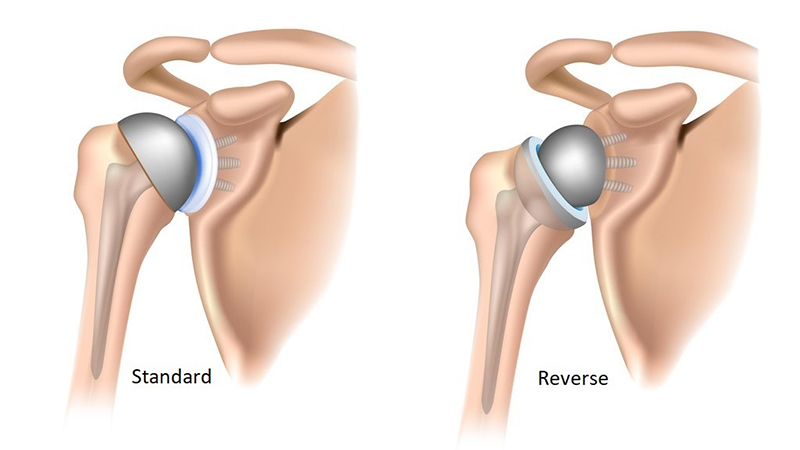
Total shoulder arthroplasty replaces both the humeral head (ball) with a metal stem and head component, and the glenoid (socket) with a polyethylene cup. The natural anatomy is preserved — the rotator cuff continues to power arm movement by pulling the new metal ball into the socket. TSA provides excellent pain relief and functional outcomes for arthritis patients with a functioning rotator cuff.
Reverse shoulder arthroplasty inverts the normal anatomy — the metal ball (glenosphere) is fixed to the glenoid and the socket (polyethylene cup) is placed on the humeral stem. This ingenious design allows the deltoid muscle to power arm elevation independently of the rotator cuff — restoring movement in patients where the cuff is completely absent or irreparably torn. RSA is the fastest-growing shoulder surgery in orthopaedics.
Hemiarthroplasty replaces only the humeral head — the native glenoid socket is preserved. Used for avascular necrosis in early stages, complex fractures in younger patients where glenoid cartilage is healthy, and selected cases where glenoid bone stock is insufficient for a full socket implant.
This is the most commonly asked question by patients considering shoulder replacement. The answer is determined by the state of the rotator cuff — not by patient preference.
| Feature | Total Shoulder Replacement (TSA) | Reverse Shoulder Replacement (RSA) |
|---|---|---|
| How it works | Metal ball on humerus, plastic cup on glenoid — natural anatomy | Metal ball on glenoid, plastic cup on humerus — reversed anatomy |
| Rotator cuff requirement | Intact, functioning rotator cuff required | Works without a rotator cuff — deltoid powers the arm |
| Primary indications | Glenohumeral arthritis, RA, AVN with intact cuff | Rotator cuff arthropathy, massive irreparable cuff tears, complex fractures |
| Expected arm elevation | Often 140–160° with good rehab and intact cuff | Typically 90–120° overhead elevation reliably achieved |
| Rotational strength | Good external and internal rotation | External rotation may be limited without cuff repair |
| Typical patient age | Often younger (50–70s) with good bone quality | Often older (60–80s) or younger with massive cuff failure |
| Long-term restrictions | Avoid heavy overhead loading | Avoid heavy lifting; no shoulder pressing activities |
Shoulder replacement is just one part of the full spectrum of shoulder care available at Manipal Hospital Jaipur. Dr. Talreja treats the complete range of shoulder conditions.
Arthroscopic shoulder surgery for rotator cuff tears, labral repair, impingement, SLAP tears and shoulder instability — minimally invasive, day surgery, faster recovery.
Shoulder Arthroscopy →Frozen shoulder (adhesive capsulitis) treatment — from physiotherapy and hydrodilatation to arthroscopic capsular release for resistant cases that don't respond to conservative management.
Frozen Shoulder →Shoulder dislocation reduction, rehabilitation and surgical stabilisation (Bankart repair) for recurrent shoulder instability — preventing ongoing episodes that damage the joint.
Dislocated Shoulder →Arthroscopic rotator cuff repair, SLAP tear surgery and shoulder impingement treatment — restoring pain-free overhead function and return to sport and work activities.
Rotator Cuff →Most patients are surprised by how quickly they regain comfortable sleep, pain-free daily life and the ability to use their arm — within 6 to 8 weeks. Full strengthening takes 3 to 6 months.
Arm in sling. Elbow, wrist and finger exercises started. Physiotherapy begins. Pain controlled with oral medication. Discharge Day 2 typically.
Sling continued. Passive range of motion exercises — physiotherapist moves the arm. Wound healed. Sleeping more comfortably.
Sling discontinued. Active-assisted exercises. Driving permitted with surgeon clearance. Return to light desk work and daily activities.
Progressive strengthening programme. Most patients are sleeping well, using arm for daily activities comfortably, and driving without restriction.
Full functional recovery. Return to swimming, golf, light recreational sport. Heavy overhead loading and contact sport restricted long-term.
Pristyn Care cited ₹1.5L–₹2L — this is a base estimate. The full range below reflects implant type, complexity and hospital stay at Manipal Hospital Jaipur.
A personalised estimate is provided after consultation, X-ray and MRI review.
Dr. Harish Talreja brings expertise in both total and reverse shoulder arthroplasty — selecting the correct implant type based on rotator cuff integrity, bone quality and patient functional goals — with comprehensive pre-operative planning and a structured post-operative rehabilitation programme at Manipal Hospital Jaipur.
Joint Replacement Procedures
Years Experience
Both Techniques Available
Book a consultation with Dr. Harish Talreja at Manipal Hospital Jaipur for an expert assessment, MRI review, and a clear recommendation — surgery or not, and exactly which type if so.
Shop No. 2/34, A Block
Vaishali Estate Township, Gandhi Path West
Jaipur – 302021
Book Appointment ›I had a good experience consulting with the doctor and he's really well mannered.
Feel free to pay us a visit. You won’t regret it for sure.