TOTAL KNEE REPLACEMENT SURGERY
- Home
- TOTAL KNEE REPLACEMENT SURGERY
What is Avascular Necrosis of the Hip
If your knee is damaged by osteoarthritis, fracture, or injury, it may be tough for you to do normal movements, such as climbing stairs or walking. You may also cause to feel hurt while you are resting or sitting down. If nonsurgical methods like pills and applying walking supports are no longer effective, you may want to think about total knee replacement surgery. Total Knee replacement surgery in Jaipur is safe and effective to reduce the pain, suitable leg damage, and help you continue regular work.
What is Total Knee Replacement Surgery:
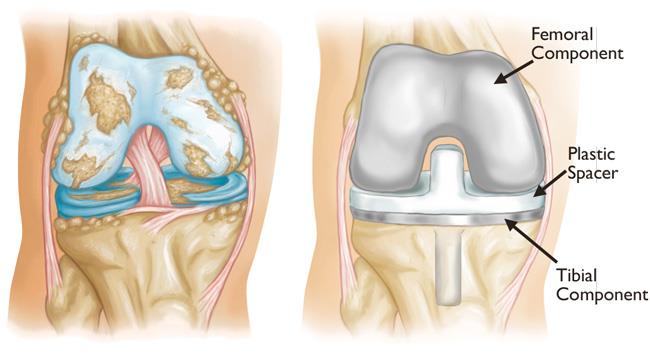
A total knee replacement surgery method is how the infected knee joint is substituted with an artificial substance. The knee is a joint which gives movement at the position where the femur meets the lower leg. The femur joins the huge bone of the lower leg at the knee joint. During a knee replacement surgery, the end of the femur bone is eliminated and replaced with an element nut.
What Happens During the Knee Replacement Procedure?
The most knee replacement surgery procedure is performed under a mix of general anesthesia, nerve blocks, and spinal (epidural) anesthesia. You will likewise get at any rate one portion of anti-microbials to reduce the risks of infections. During the procedure, the knee replacement surgeon will eliminate bone and infected ligament from where your thigh bone (femur) and shin bone (tibia) meet at your knee joint. Those surfaces are then supplanted with a metal embed. A piece of unique plastic is typically used to supplant the rear of the kneecap lastly, this equivalent plastic material is set in the middle of the two metal parts.This gives the two bones of your knee joint smooth surfaces again so they can flex and twist all the more openly and effortlessly.
Causes of Knee Replacement
Rheumatoid arthritis: In this condition, the synovial layer that encloses the joint converts swelled and stiffened. This continued swelling can hurt the cartilage and ultimately cause cartilage damage, injury, and stiffness.Osteoarthritis: This is an age-related type of disease. It normally happens in people who have 50 years and old but may happen in younger people, also. The cartilage that cushions the osseins of the knee bends and carries away. The bones then rub on one another, creating knee injury and pain.Post-traumatic arthritis: This can arise a dangerous knee injury or fracture. Breaks of the bones girdling the knee ligaments may destroy the articular cartilage over age, producing knee hurt and restricting knee capacity.
When Knee Replacement Surgery Is Recommended:
There are many reasons to prescribe knee replacement surgery by Doctors.
Having knee pain while relaxing, either day or bedtime
Your knee pain restricts your daily routine activities like walking, seating, running and also resting.
Having swelling and hardness in the knee after medication.
Knee deformation
Your Recovery at Home:
The completion of your operation will depend mostly on how properly you attend your orthopedic consultant guidance while you are at home the first few weeks after surgery.
Avoiding stair-climbing until prescribed by your orthopedic doctor
To decrease your knee inflammation, you may use ice to the knee.
Take painkillers for relieving pain as prescribed by your doctor.
By seeing a doctor in a clinic, you can remove stitches.
A progressive walking schedule to gently improve your movement, mobility, and motion initially in your home.
Avoid driving until your doctor tells you to do.
Using a walker until your knee performs the right movement and motion.
Avoiding falls
Total Knee Replacement Surgery in Jaipur Costs
Cost can differ, depending upon where you have the technique and your general health around that time.If you have different conditions that are not identified with your knees, they may affect the method and cost also.While thinking about the costs of the procedure, you ought to likewise consider extra expenses for:
Your medical clinic stay
Physical therapy in the hospital
Treatment during your recovery at home
Follow-up appointment and care
Finding support at home
Transportation costs
Who should consider Knee Replacement Surgery in Jaipur?
Osteoarthritis is a typical explanation that individuals have knee medical surgery however surgery may likewise be required in individuals with:
a knee injury, for example, a tendon tear or meniscus tear
a knee deformity that they were born with
rheumatoid arthritis
The vast majority with knee pain absolutely never require surgery and can be treated non-operatively. Your surgeon may suggest:
shedding pounds
getting more exercise or following a particular exercise plan
using over-the-counter or other medications
injections
Notify your doctor to report any of the following:
Having Fever after surgery
Inflammation, swelling, redness in the affected area, bleeding, or another drainage from the surgery place
Increased pain around the surgery area
Take the Best Advice about total knee replacement surgery in Jaipur from experienced Dr. Harish Talreja (Knee replacement surgeon in Jaipur)
Takeaway
Total Knee replacement surgery in Jaipur is a normally performed activity. After surgery and recovery, numerous individuals can partake in exercises they used to do, like strolling, bicycling, golf, tennis, and swimming. While there is always an element of risk with any surgery, this technique is viewed as safe, and the vast majority experience a decrease in pain and greater mobility. Prior to choosing to go on, notwithstanding, examine the advantages and risks with your medical care supplier, including the expense and the measure of time you may require off work. For some, knee replacement surgery can improve their capacity to work from one day to another and their quality of life.
Call Us Today for Consultations
Feel free to pay us a visit. You won’t regret it for sure.